


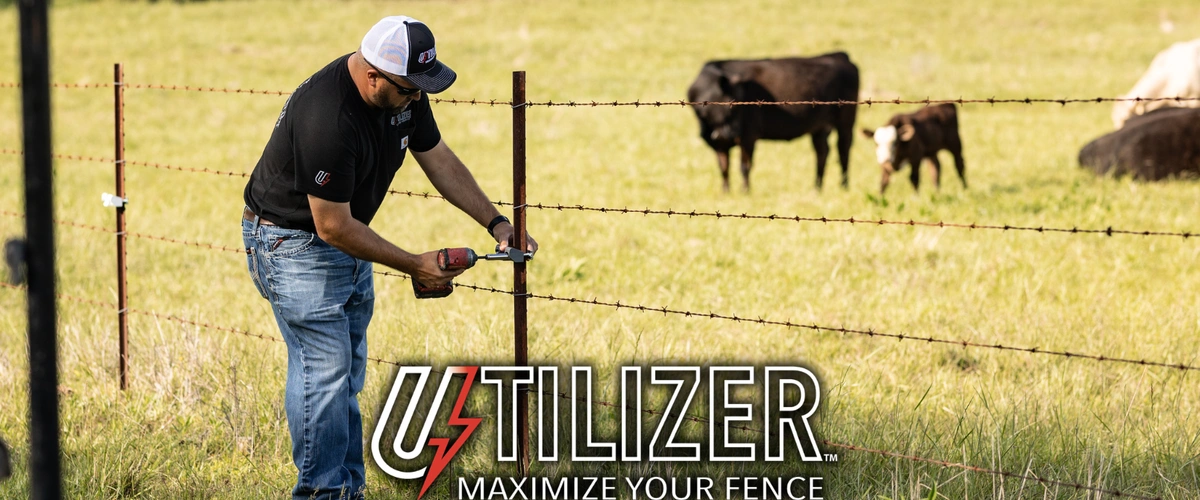


You already know what the problem looks like. Staples pulled. Posts leaning out. A stretch of woven wire bellied out where the herd works the corner by the water tank. And a charger reading half of what it should, because the hot wire is resting against steel somewhere out in the middle of a mile of fence.
None of that is a fence problem. It is a contact problem. Cattle that can reach your fence will lean on it, and a fence that gets leaned on will fail — every single time, on every operation, regardless of how well it was built.
The fix is not building a heavier fence. It is keeping cattle off the one you already have.
Why Offset Hot Wire Works Better Than a Stronger Fence
An offset stand-off puts a hot wire 15 inches in front of your existing fence line. The animal meets the charge before it ever meets the fence. That changes three things at once:
- No contact means no pressure. Posts stay plumb, wire stays tight, and corners and gate areas — the spots that always go first — stop taking the load.
- No contact means no grounding. Hot wire separated from barbed or woven wire cannot short out against it. Your voltage stays where the charger put it.
- Consistent voltage trains faster. Cattle learn a fence that bites the same way every time. They do not learn a fence that is hot on Monday and dead on Thursday.
That is the whole thesis behind Utilizer. The brand started on a working farm, out of frustration with broken, bent, weathered fence components that never lasted a season. Corey and his father-in-law — both experienced electric linemen — put their electrical knowledge into hardware built to hold. We have lived it on our own farms, which is why the line is built the way it is: galvanized steel, permanent hardware, no plastic clips that crack in the first hard freeze.
The Utilizer Line on Agzaga.com
Four products. One system. Here is what each one does and when you need it.
1. Utilizer Electric Fence Extension Stand-Off Kit — The Build It Better Bundle
This is the starting point and the flagship. It is the complete 15-inch offset system: brackets, rods, and clips together, ready to run hot wire in front of your existing fence.
- Mounts directly to standard T-posts — no drilling, no fence tear-down, no specialty tools. A 1/2" socket is all you need.
- Works with high tensile wire, polywire, polyrope, polybraid, and polytape, so it drops into whatever you are already running.
- Heavy-duty, corrosion-resistant galvanized steel — built for real cattle pressure and real weather, not a temporary patch.
- Protects high-stress zones first: corners, gates, feeding areas, and anywhere the herd crowds.
Best for: Anyone dealing with active cattle pressure, repeat fence repairs, or voltage loss on an existing barbed or woven wire fence. Start here.
→ Shop the Utilizer Electric Fence Extension Stand-Off Kit on Agzaga.com
2. Utilizer 3/8" x 15" Fiberglass Fence Rods — 12 Pack
The rods are what hold your hot wire out away from the fence. Non-conductive fiberglass means the offset stays insulated by design — there is no plastic insulator to crack, melt, or work loose.
- High-quality fiberglass, weather-resistant, consistent 3/8" x 15" sizing across the pack.
- Keeps wire positioned and insulated without added hardware.
- 12 per pack — buy by the run, not by the piece.
Best for: Extending an existing offset run, or replacing rods that have taken a hit from equipment or weather.
→ Shop Utilizer 3/8" x 15" Fiberglass Fence Rods (12 Pack) on Agzaga.com
3. Utilizer 3/8" Galvanized Steel No-Slip Spring Clips — 12 Pack
The clips are the small part that decides whether the whole system is a five-minute job or an afternoon. They snap your hot wire onto a 3/8" fiberglass rod in seconds — no tying, no extra hardware, no tools.
- Locks wire at consistent tension so the line does not sag or slip out of position.
- Galvanized steel — holds up where weak connections and plastic fail.
- Sized specifically for 3/8" fiberglass rods.
Best for: Replacing lost clips or expanding an existing Utilizer stand-off setup. Keep a spare dozen in the truck.
→ Shop Utilizer 3/8" No-Slip Spring Clips (12 Pack) on Agzaga.com
4. Utilizer Poly Wire Reel Holder — Quick-Attach T-Post Mount
If you are running temporary fence or rotational grazing, the reel is the part you fight with. This holder gives you a secure mounting point exactly where you need it, using the same Quick-Attach system as the rest of the Utilizer line.
- Mounts fast to a T-post — attach, hang the reel, go.
- Keeps poly wire controlled and accessible during setup, take-down, and daily moves.
- Shares the Quick-Attach system with Utilizer brackets, so the hardware is consistent across your setup.
Best for: Rotational grazing operations and anyone moving temporary fence on a regular schedule.
→ Shop the Utilizer Poly Wire Reel Holder on Agzaga.com
How to Build the System: A Simple Order of Operations
- Start with your worst 200 feet. Corners, gate approaches, water and feed areas. That is where your repair hours already go.
- Install the Stand-Off Kit on your existing T-posts. No tear-down. Bring a 1/2" socket.
- Run your conductor of choice and clip it on. High tensile, polywire, polyrope, polybraid, or polytape all work.
- Check voltage before and after. The number will tell you what the fence was losing to contact.
- Expand down the fence line with rod and clip 12-packs as you go.
Frequently Asked Questions
Will an electric fence offset really stop cattle from leaning on the fence?
Yes — that is the entire mechanism. The hot wire sits 15 inches in front of the fence, so the animal makes contact with the charge before it can reach the fence to lean, rub, or push. After a few encounters, cattle learn to keep their distance from the whole fence line.
Do I have to take my existing fence down to install a stand-off bracket?
No. Utilizer brackets mount directly to standard T-posts with a 1/2" socket. No drilling, no tear-down, no rebuilding. You are adding to the fence you already have.
Why does my electric fence lose voltage?
The most common cause is the hot wire touching barbed wire, woven wire, or a steel post somewhere along the run — the charge grounds out and voltage drops across the whole system. Keeping the hot wire physically separated with an offset removes that failure point.
What wire works with Utilizer offsets?
High tensile wire, polywire, polyrope, polybraid, and polytape. If you are already running it, the system takes it.
Why galvanized steel instead of plastic clips?
Plastic clips crack and fail under sustained cattle pressure and UV exposure. Utilizer is built from heavy-duty, corrosion-resistant galvanized steel because the hardware is meant to be permanent, not replaced every season.
Where can I buy Utilizer electric fence products?
The full Utilizer line — stand-off kits, fiberglass rods, spring clips, and poly wire reel holders — is available at Agzaga.com, shipped direct.
Install It Once. Protect the Fence for Good.
Every repair you make on a fence cattle can reach is a repair you will make again. The offset changes the math: less pressure, less grounding, fewer repairs, and a charge that actually holds.
Build a farm that is stronger for generations to come — starting with a fence that holds this season.
→ Shop the full Utilizer electric fencing collection at Agzaga.com


